While I was conceptualizing the theme “Love With Hands,” I discovered the artist Maria Maksacheva via Instagram. Her work combines recollections, familial life, and a vibrant red, that offers viewers a sense of flesh and vulnerability. Her recent work centers hands without facial features. I immediately dm’d her intrigued by her relationship to hands.
Maria and I met at her exhibit at the Paname Art Cafe, a comedy venue and restaurant that supports local talent across Paris. Rain taps against the window as I watch Maria mingle with guests. She walks over carrying one of her paintings. She sits wearing a burgundy top that highlights a tousled, shoulder-length bob.
monica sharel: In 2022, you posted a carousel of various images of hands. Do you remember that post? Is there anything specific about your relationship to hands?
Maria Maksacheva: When I first meet someone, I always look at their hands. It’s one of the things I notice. My dad would always say that you can know a lot about a person by their hands. I can tell how a person cares for themselves, what type of work that they do. If a person bites their nails, maybe they’re stressed. It’s similar to what people say about shoes.
ms: When you see your own hands, what do you think?
MM:It took me a while to accept my hands as beautiful. To recognize that they were also the hands of a creator—and the hands of a woman at the same time. While painting, I would paint the same nails I had in the picture. There is a painting of hands with stars. A personal detail.
ms: This focus on hands seems to carry over into your paintings, where they’re often the main focal point.
MM: In my paintings, I used to create only self-portraits. For my latest works, I wanted to focus on details, hands on being one of them. I think they tell their own story. For instance, a little girl’s hand on her dress is something very innocent. There is also a painting with my grandfather’s hands—he works a lot with his hands. You can see that story in his hands. Hands can tell a story.
mf: From the beginning, I would say that hands are our first tools. There is little we do without them. I see them as the physical way we bring the intangible into existence. When you have an idea, how do you bring that into form?
MM: When I have an idea… I directly have a vision in my head.
ms: You see it immediately?
MM: The picture? Yes. Afterwards, I take a picture of myself in the position that I want to draw. Then I assemble images. Particularly with Hope/The One I Saved. I can tell you the story behind that one.
ms: Please.
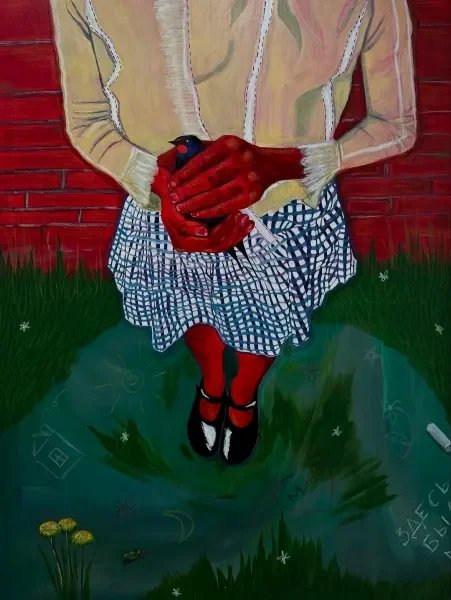
Hope/The One I Saved, (2025) Maria Maksacheva, Photography: Louise Metzger Koza
MM: When I was little, I stayed at my grandparent’s house in the countryside. There was a very old red brick church undergoing construction. In the upper part of the cathedral near the steeple, I saw a bird trapped inside. It was hitting herself against the window. I wanted to help it. So, I started to climb all the construction stuff to catch it. I caught it once and started to run down, but it escaped and flew away. So I wandered around again, then tried again, and caught it again. I finally walked outside the cathedral with the bird in my hand. Once outside, I opened my hands, and she flew away. I returned to my grandparents’ home and told my grandma. She said, “Oh, you liberated a trapped soul”. And I always remember what she said. It was that memory I wanted to represent.
ms: What is that memory specifically?
MM: It was holding a soul between my hands.
ms: What is it about the color red that you use in your paintings?
MM: In the beginning, I painted a red and blue character. It was in school during that time. It was my first painting after finishing art school. It seemed to me that the red was so powerful. The look on her face. The emotion that I felt when she [painting] looked at me. My friends told me that the red made them feel what’s under the skin could be. The blood. It gives a universal feeling since underneath we are flesh and blood.
ms: You mentioned powerful, do you mean in the context of strength or vulnerability?
MM: A mix of it. Something tender and vulnerable. I also like the mix of violence and intimacy that this color elicits.
ms: While I was conceptualizing the theme of Love With Hands, I was thinking about how violence can be enacted through our hands. Our actions that cause harm. Your memory of freeing the bird demonstrated tenderness. The red juxtaposes that with the raw flesh-like quality. So I read about the origins of your family. It seems that they are central characters in reference to your art. I read that your grandmother taught you how to sew and your grandfather how to build. Those are very practical things. Do you believe that these had any influence on your life as an artist?
MM:I always enjoyed the fact that I could almost do everything myself. I can repair which is pretty satisfying. Regarding my grandmother, grandfather, and my mother, they are super practical. They are engineers. It’s only my father’s side that everything is
very sensitive and passionate. I think I got poetic and artistic from my father’s side.
ms: Your origins are Russian. You were born in Canada and raised for a good deal of time in France. Do you believe any of these have shaped you in a particular way?
MM: I think it’s when I left Russia and came to France. Then, once in France, I changed schools and cities. Each time, I would have to re-adapt all over again. I was always a shy, introverted kid. So I had to put extra effort into feeling comfortable in places.
ms: Would you describe yourself as an easily adaptable person?
MM: I think now I am adaptable to a point that I came to a realization that I’m not attached to anything, and that I could change places, change jobs, change friend groups, or whatever it is, very easily. In the beginning, that made me feel lost as well – to not have any attachments. It raised questions around how do I create a safe space to live if the space is not mine. So I think you have to find the balance between being free and attached. My first exhibit was named “My Houses Where I Put My Feet,” was about that.
ms: Specifically, there was a piece that you created “The Love Of My Grandfather/Boris”. It evoked a personal memory of my own grandfather who liked to build and tinker with things. There was an immediate nostalgic pull of familiarity to this piece. Was it hard for you to let this piece go?
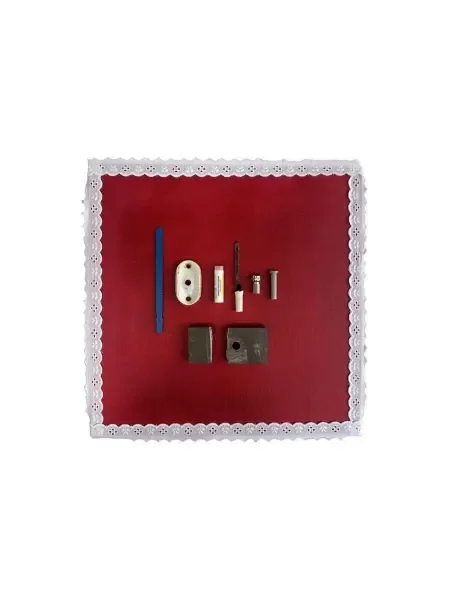
The Love of My Grandfather/Boris, 2025, Photography: Louise Metzger Koza
MM: At my first exhibit, I thought I could not sell anything. So I kind of priced it very high, thinking, at least I’ll get a lot of money from it if it sells. Then one year later, after the exhibit, I was mentally prepared to let it go. I think it’s a very important step in the career of an artist to let things go.
ms: Do you find being an artist in France difficult?
MM: It’s a bit academic. I mean, you have to go through certain schools to achieve certain things. Galleries go directly to these institutions, so if you’re an artist who doesn’t want to follow the same steps, you have to learn everything yourself. You have to be your entire team. I think it’s definitely possible because it’s working for a lot of people, so it’s just a question of how much effort you put into it and to what extent you go out of your comfort zone.
ms: Speaking of comfort zones. At your exhibit “Under The Apple Tree,” you lit a candle before the start. There was also a collective exhibition where you presented an artwork with a mirror and a poem with steps that led to a mirror. Can you speak to the performance element that you create with your artwork?
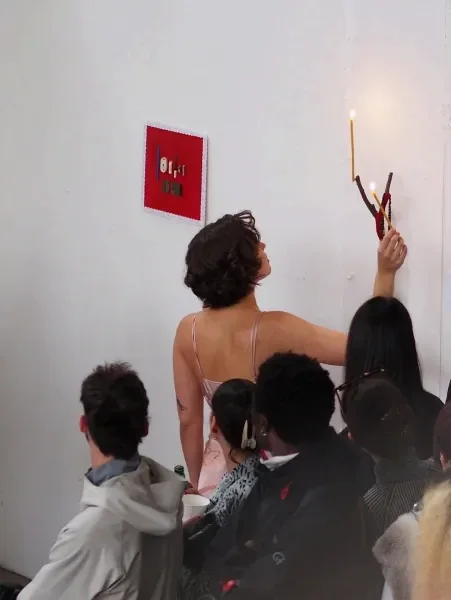
Under The Apple Tree Exhibit (2025)
MM: I like the fact that people can kind of enter my world. A painting is flat. So people sometimes just pass and don’t stop. So I wanted to have something that they could stop and interact with. I want a conscious thought for the audience to step into. Regarding the candle, I was actually really nervous, but it made the experience more personal.
ms: So you’ve finished the exhibit. What’s next?
MM: I want to find a space again. Recently, I’ve been creating from my kitchen. With a full-time job, there is also a need to try to find time to create. I will continue to paint. I would like to be represented by a gallery or someone who can help with things I don’t have time for anymore. Someone who could be a support. Last, I recently did a commission for a woman who came to one of my exhibits and liked “The Love of My Grandfather”. It had already sold, but I offered to create something for her. It became an intimate process, since I assembled personal belongings: the tooth of her horse, her dog’s favorite stick, and other belongings. It felt like I was a part of her world. I think it was my favorite experience I’ve ever had in the world of the arts.
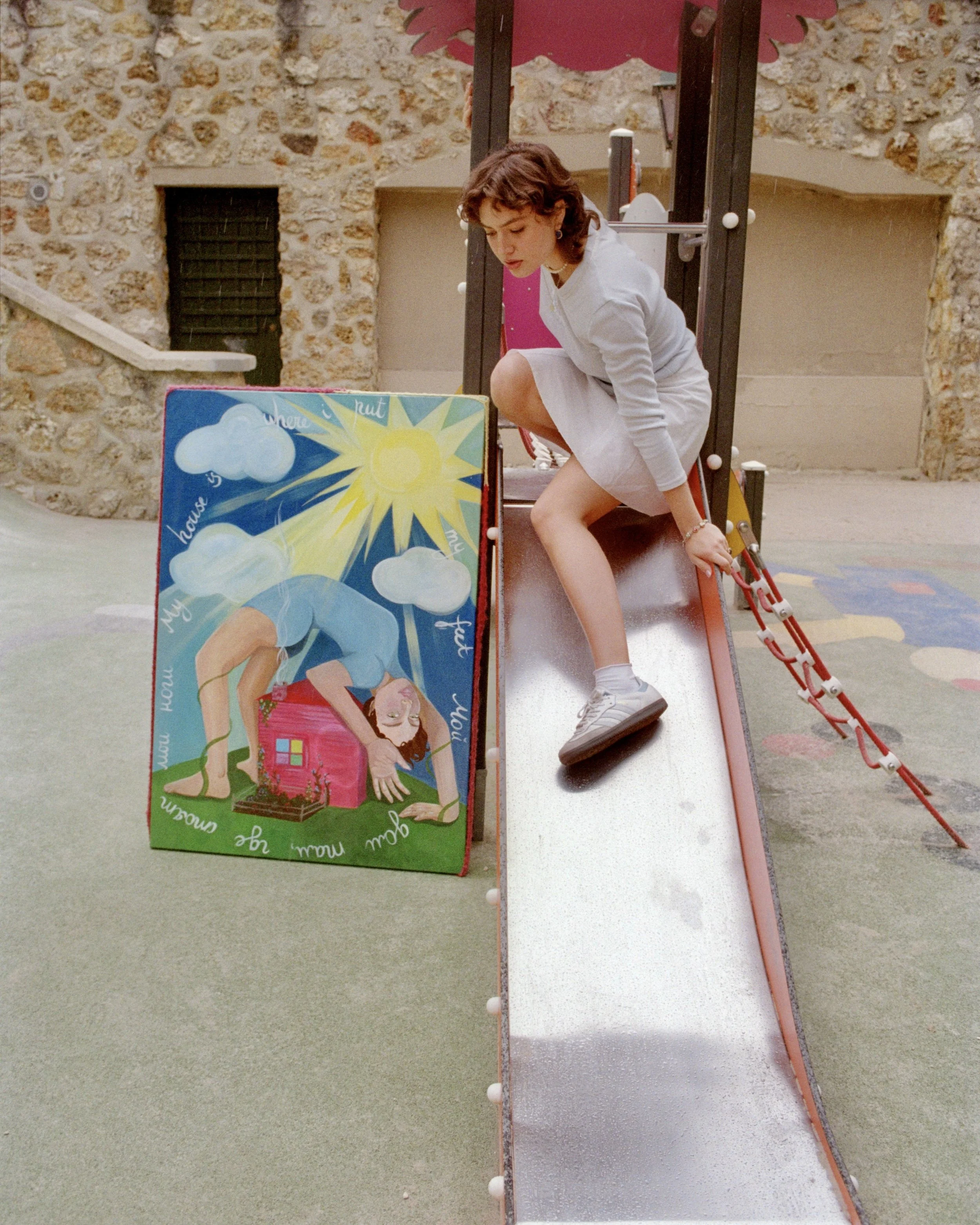
Maria Maksacheva, Photography: Amore Pauline
For more information about Maria Maksacheva
Photo Credits: Louise Metzger Koza , Amore Pauline
