Writer Diaries 001
Asking for money is embarrassing.
Unless you are someone of importance. Importance. It opens doors. Being unimportant thrusts you between “Lunch ran over, sorry” and “I have a hard out in 15, sorry.”
My fingers hover above a dry, ketchup-stained keyboard. “Sure, no problem, see you soon.”
Last week was eventful for moving Chez Nous, my film, forward;
When Sloane’s French adoptive mother, Maud, and sister, Clemence, arrive unannounced at her apartment, Maud’s advancing dementia has left her remembering only Sloane—forgetting her biological daughter—reopening a decade of old wounds between the sisters.
Transparently, I wrote Chez Nous from a selfish place. I want to act in French. Therefore, I wrote it. Without connections, I find myself standing in the role of a producer.
Monday, August 17th.
Ninety minutes had passed as I sat in my plush orange chair in front of the window. The sun’s glare blocked out the screenplay displayed on the laptop. The time read 15h37. Two scenes were still left, which would take the entirety of the day. Draft 6 was to fix the story’s structure, since my initial process for writing begins when an idea bursts at the seams of my cerebrum and pressurizes until I have to write it out. From there, I write three pages a day until the first draft is finished. In short, writing for me is instinctual first. The process of producing Chez Nous is stretching me; I am collaborating with other writers and their methods. I glance back to the scene outline I learned to make to ensure that each scene adds up to the next. What I also discovered during this draft was Maud. Her character at the start was destitute, a 63-year-old woman whose condition of dementia overshadowed someone who was fighting to hold on to her life as well. I wrote her flat, a mere lurking plot device. It was during an audition that an actress shifted Maud to a woman who was experiencing dementia and not someone who had dementia. The actress played Maud coming in and out of lucidity: scared when she didn’t recognize her surroundings, equally elated when she saw Sloane. The scenes between Maud and her daughters became vibrant. Maud retained an impish youth despite her circumstances.
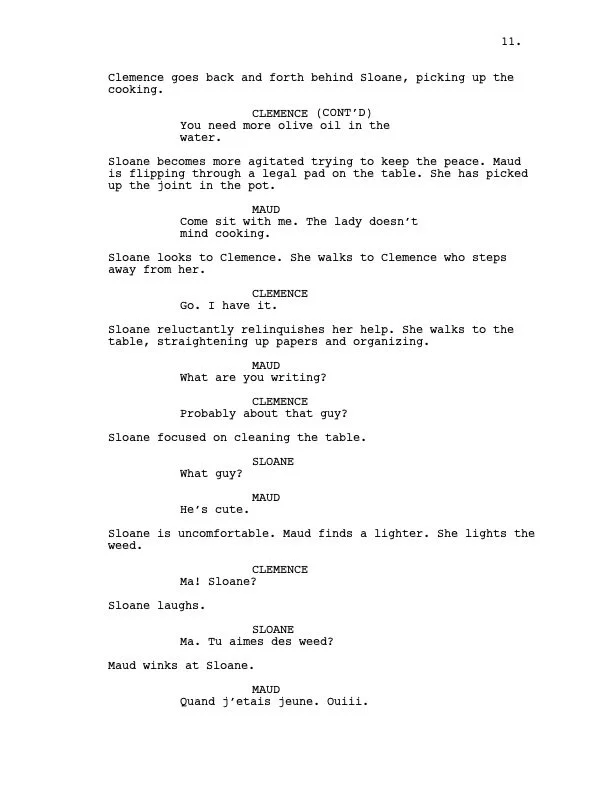
Maud picking up a blunt to smoke allowed room for the sisters’ relationship to her to become more pronounced. Each time my fingers stroked the keyboard, words began to build the bones and flesh of Maud.
Tuesday, August 18th.
Walking past closed bookstores, I switched between Google Maps and WhatsApp, my reflection carrying a heavy tote bag. The streets of Paris were quiet. It was the last week before the city’s inhabitants bustled back, trailing plumes of cigarette smoke, bike chimes, and insistent honking behind them. I caught my reflection in the window of the coffee shop TANAT. I checked the time: it was 8:45 a.m, I would be late. I definitely need coffee. I stepped inside, met with reddish teak cabinets, the quiet, and the coffee’s coconut aroma.
“Je vais prendre un latte au lait d’avoine,” I said, instead of ordering my usual bitter long black.
Walking out, I juggled the heavy tote bag, a phone switching between apps, and a piping hot latte. The streets became more frenetic as people in polo shirts, asymmetrical skirts, low-rider jeans, tanks, loafers, Doc Martens, and nameless thick, chunky knee-high boots clustered on corners, taking photos with their phones and cameras. I sped up arriving at Zone 34, an actor studio that had generously allowed us to use their space for the auditions. I walked in, threw the tote bag on a couch, relieving my uneven shoulder, and helped the guys set up.
We were finalizing casting for the role of Clemence. The Assistant Director and I carried a wooden table, setting it behind the camera and monitor. I looked around the room. It was my first time behind the monitor instead of in front of its penetrating lens. Today I would be the pair of eyes that assess each actresses’ performances. It was through this process that my definition of film and theatre was sharpening. Film requires subtlety and sustained attention. Theatre takes great stamina, presence, and ingenuity. As each actress stood in front of us, I jotted down pivotal questions for myself as a viewer.
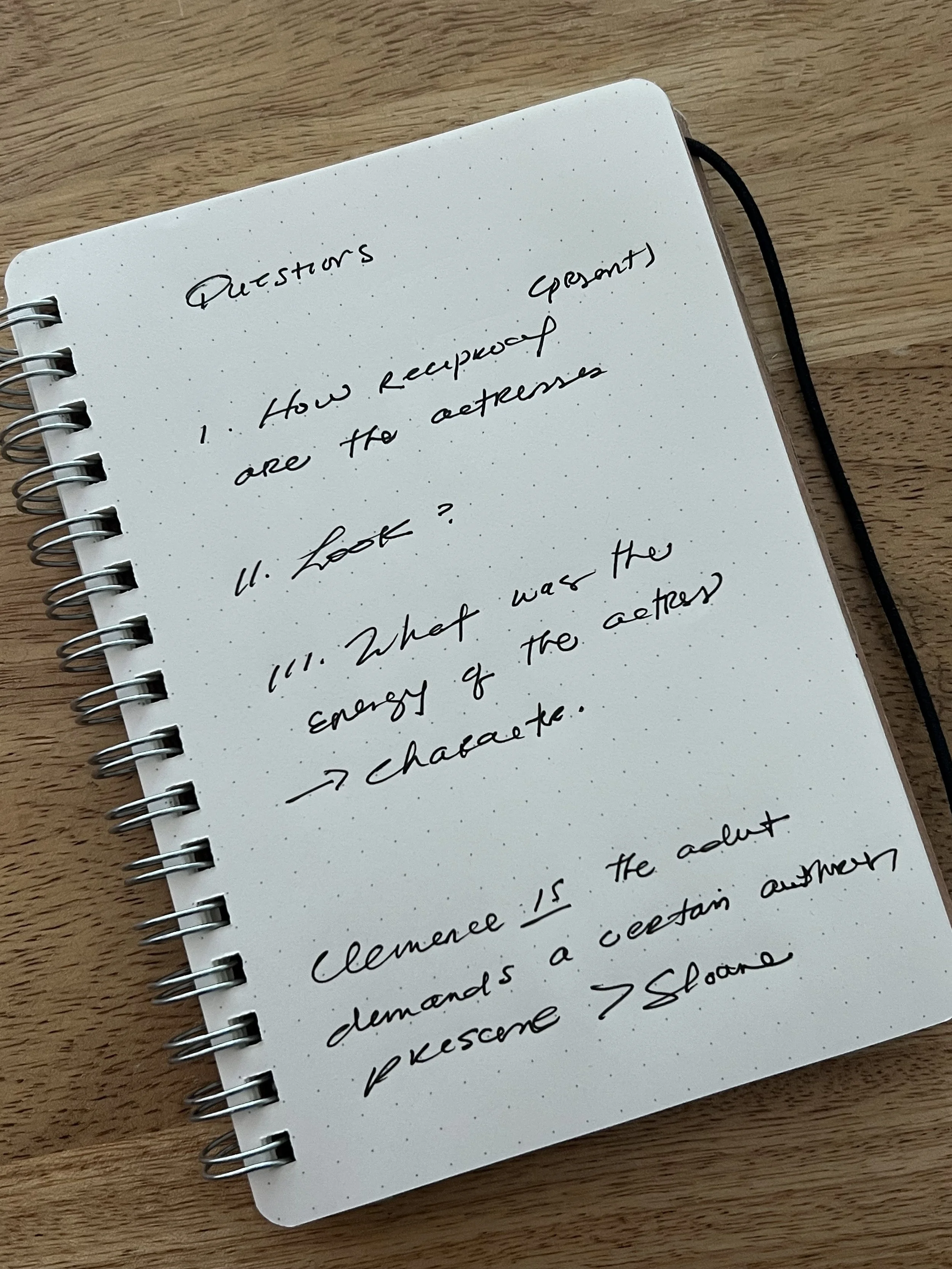
If done well, you spark the writer and discover additional nuances of the character. I realized, as an actress, that I must find something revelatory about the character that even the writer might not know.
Wednesday, August 19th.
My ring finger hits the delete button on the keyboard. I type 10,000k. Then delete. I type 5k. No, go big or go home. All they can say is no. I deleted the 5k. Looking at the cursor, I am queasy. I reread the deck from the top when a Gmail notification pops up on the screen.
“Lunch ran over, sorry.” My fingers hover above a dry, ketchup-stained keyboard. “Sure, no problem, see you soon.”
The meeting starts with catching up, as it’s been a while since the person and I have seen one another. As I trail into the story,
“I have a hard out at 15, sorry.”
I bite the inside of my lower gum. I launch into the story. Seven minutes later, time is up. There is no promise. The industry that was once thriving is now going through layoffs and a changing landscape.
“Send the pitch deck and script. I will read.”
After the call, my ego is bruised by the information. Who was I to pitch a film with no credentials? Not a trained writer in the eyes of the industry. You started at the front desk. Here I stand, reminded that fifteen minutes is for unimportant people. People with no value yet, beyond a potential connection.
I ring a friend, speaking my internal dialogue out loud.
She reminds me, “We are all somebody.”
I think of Maud, and what it took for an actress to see her as more than where she was now.
I retype 10k. Attach the deck. Sent.
